
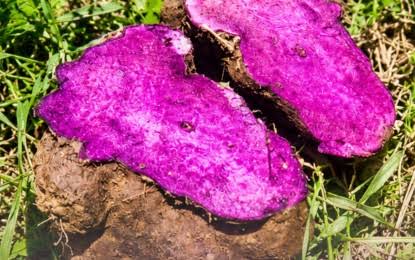
The Filipino purple yam has gone from a beloved local dessert staple to a global food trend — and demand is now putting pressure on the country’s supply.
Ube has officially entered its global era.
The vibrant purple yam, long associated with Filipino desserts such as ube halaya, ice cream, cakes, and pastries, is gaining popularity overseas, appearing in drinks, desserts, and menus across the United States, United Kingdom, and other international markets.
But as global interest in the distinctly Filipino ingredient continues to grow, the Philippines has made an unusual move: the government has indefinitely suspended exports of fresh ube.
The Department of Agriculture (DA) said the suspension was imposed to protect the country’s limited supply of planting materials while the government works to increase domestic production. The Bureau of Plant Industry began implementing the measure in August, covering fresh ube and propagative planting materials intended for consumption, planting, or research.
Agriculture Secretary Francisco Tiu Laurel Jr. said the Philippines currently lacks enough planting material and does not want Philippine ube varieties being exported and potentially used to establish competing production overseas.
From Filipino staple to global food trend
For Filipinos, ube is hardly a new discovery. It has long been a familiar flavour in traditional desserts, from halaya and puto to ice cream, pastries and more modern creations.
Outside the Philippines, however, ube has increasingly become a trend in its own right.
Its naturally vivid purple colour has made it particularly popular on social media, while its mildly sweet, nutty and creamy flavour has helped it find its way into coffees, cocktails, pastries and other contemporary dishes.
The Guardian reported earlier this year that ube drinks had begun appearing across the UK, with Starbucks and Costa Coffee introducing ube beverages. The publication described the ingredient as a growing trend driven partly by its striking appearance and popularity on platforms such as TikTok.
The trend has continued to gain momentum. Recent international reports have highlighted growing demand for ube in the UK and other markets, with the ingredient increasingly being treated as more than an exotic flavour — and instead as a mainstream food trend.
Why is the Philippines limiting exports?
The export suspension is less about stopping the world from enjoying ube and more about making sure the Philippines has enough ube to grow its own industry.
The government wants to expand production and eventually capture more value from the ingredient’s growing international popularity. But farmers currently face limited access to quality planting materials, making it difficult to increase production quickly.
The DA is pursuing several measures to address the shortage, including tissue culture, community-based nurseries, and mini-set propagation to increase the availability of planting materials.
The government and industry have also formed the United Ube PH Association, bringing together farmers, processors, traders, exporters and researchers to help develop the sector.
The government is also working with the University of the Philippines Los Baños to genetically map Philippine ube varieties. The initiative aims to help protect native varieties, establish authenticity in export markets and support the development of stronger and higher-yielding varieties.
The ube boom could be a bigger opportunity for the Philippines
The current situation highlights an interesting challenge for one of the country’s most recognisable food ingredients.
The Philippines already exports ube products including powder, halaya, jam and paste to markets such as Canada, the Middle East and parts of Asia. The government also sees opportunities to expand into markets in the United States, South Korea and Europe.
To support that expansion, President Ferdinand R. Marcos Jr. has approved a ₱300-million budget for the ube industry for 2027, according to the DA.
Importantly, the current suspension applies to fresh ube and planting materials, rather than all ube products. Value-added products such as ube powder, halaya, and paste can continue to be exported.
For now, the Philippines is essentially facing a uniquely Filipino problem: the world wants more ube, but the country needs to grow more of it first.
And as the purple yam continues appearing in international cafés, bakeries and dessert menus, what was once a familiar flavour of Filipino childhood is becoming one of the country’s most recognisable food exports.